

The Hidden Cost of Visual Clutter on ADHD and Autistic Brains

Have you ever walked into a room and immediately felt exhausted?
Not because you had been doing anything physically demanding. Not because you were particularly stressed. But because your eyes landed on the pile of mail on the counter, the laundry basket overflowing in the hallway, the half-finished project on the dining room table, and the random collection of items that somehow migrated to every available surface.
If you're neurodivergent, that feeling isn't all in your head.
Visual clutter carries a hidden cost that many ADHD and autistic people experience every day, often without realizing just how much it impacts their energy, focus, and nervous system.
The challenge isn't that you're messy. It is that your brain is processing more information than it needs to.
Your Brain Sees Everything
Many traditional organizing experts focus on aesthetics. Make it look tidy. Make it look pretty. Make it look like a Pinterest board.
But for neurodivergent individuals, organization isn't about appearances. It's about reducing friction. Every object in your environment is information your brain must process. The unopened mail… the shoes by the door… the dishes in the sink… the donation pile you've been meaning to deal with for three months. Each item competes for your attention, even when you're not consciously focusing on it.
Imagine trying to hold a conversation while ten different people are speaking to you at the same time. That's often what visual clutter feels like for an ADHD or autistic brain. Your environment becomes noisy, and noise is exhausting.

Why Visual Clutter Feels So Overwhelming
For many people with ADHD, visual clutter creates distraction. The brain is constantly scanning the environment for stimulation. Every visible item becomes a potential interruption. You walk into the kitchen to make coffee. You notice the dishes, and the dishes remind you that you need dish soap, the dish soap reminds you that you need groceries, and the groceries remind you that you forgot to return a phone call. And suddenly you're standing in the kitchen wondering why you walked in there in the first place.
For autistic individuals, visual clutter often creates a different kind of challenge.
Many autistic people experience heightened sensory processing. A crowded environment can create sensory overload, making it difficult to relax, focus, or regulate emotions. When every surface is visually busy, the nervous system may never fully settle.
The result?
Mental fatigue.
Decision fatigue.
Difficulty focusing.
Increased irritability.
A constant feeling of being behind.
The Clutter You Stop Seeing Is Still Costing You
One of the biggest misconceptions about clutter is that if you've gotten used to it, it no longer affects you. Unfortunately, that's rarely true. Your brain may stop consciously noticing the stack of papers on the counter, but it is still processing it in the background.
Think of it like having dozens of browser tabs open on your computer. You may not be actively using all of them, but they're still consuming resources. Visual clutter works the same way. Every unfinished task, every visible reminder, every object without a designated home quietly occupies mental bandwidth. This is why so many neurodivergent people describe feeling exhausted in their own homes.
They're carrying far more cognitive load than they realize.
The Goal Isn't Minimalism
Whenever I talk about clutter, I want to make one thing very clear:
The goal is not perfection.
The goal is not a magazine-worthy home.
The goal is not to become a minimalist.
The goal is to create an environment that supports your brain.
Sometimes that means open storage because closed cabinets become black holes. Sometimes that means labelled bins. Sometimes that means keeping frequently used items visible. And sometimes it means letting go of items that are creating more stress than support.
A neurodivergent-friendly home isn't following someone else's rules; rather, it’s understanding how your brain functions and designing your environment accordingly.
Small Changes Can Create Immediate Relief
I have good news! You don't need to declutter your entire house to feel a difference. Often, the greatest relief comes from addressing the highest-friction areas first. Start with one surface… one corner… one shelf… one basket….
Ask yourself:
What is my eye drawn to every time I enter this room?
What repeatedly causes frustration?
What am I constantly moving from one place to another?
What unfinished task keeps demanding my attention?
Don’t think about reducing clutter as “doing more”. Instead, think of it as removing the obstacles that are quietly draining your energy every day.
Give Yourself Permission to Let Go of the Shame
If you've struggled to keep your home organized, you're not failing. You don't need more willpower or a stricter cleaning schedule. And you certainly don't need another organizing show making you feel like you're doing life wrong.
You need systems that work with your brain instead of against it. Because when your environment becomes easier to navigate, life often becomes easier to navigate too. The goal isn't a perfect home, but a home that helps you breathe.
Ready to create more calm and less overwhelm?
If clutter has become a source of stress, guilt, or decision fatigue, my Declutter Without Shame Guide was created specifically for neurodivergent individuals and families.
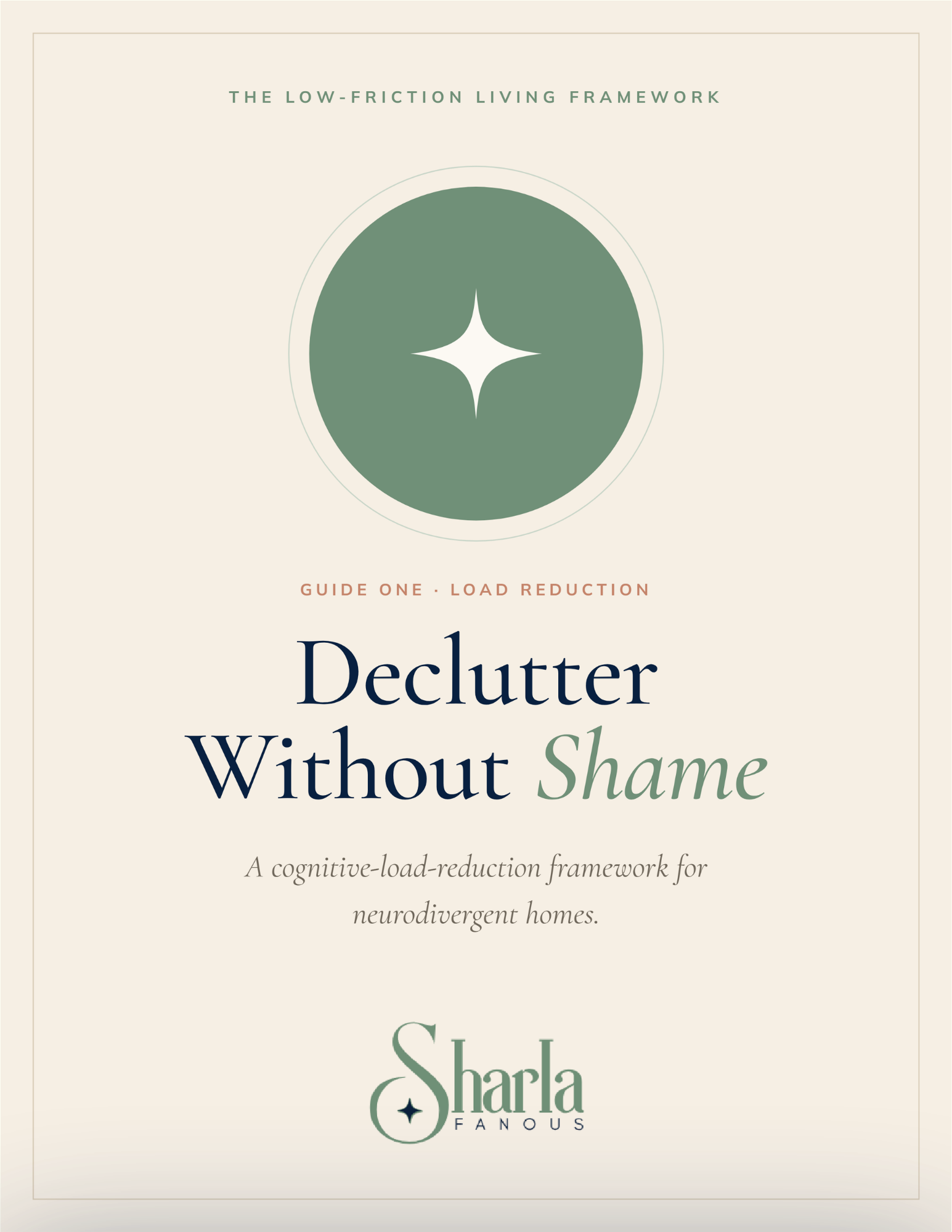
Inside, you'll learn practical, compassionate strategies for reducing clutter without overwhelm, perfectionism, or judgment.
Because lasting organization doesn't come from shame. It comes from understanding how your brain works and building systems that support it.
Get your copy of the Declutter Without Shame Guide and take the first step toward a calmer, lower-friction home today.